Here is a scenario worth thinking about. A potential customer opens ChatGPT and types: recommend a nice boutique hotel in Chiang Mai or where can I get a business website built in Thailand without paying a fortune? The AI responds instantly with names, descriptions, and recommendations.
Is your business one of them?
The way people find businesses online is changing quietly but fast. In 2025, 69% of Google searches end without a single click to any website, up from 56% just one year ago. Gartner projects that by 2026, around 25% of organic search traffic will shift to AI chatbots. If your entire digital strategy is built around ranking on Google first page, you may be leaving a growing share of potential customers unaddressed.
The good news? This shift creates a clear window of opportunity for businesses that act early, especially small and independent ones that can move faster than large chains.
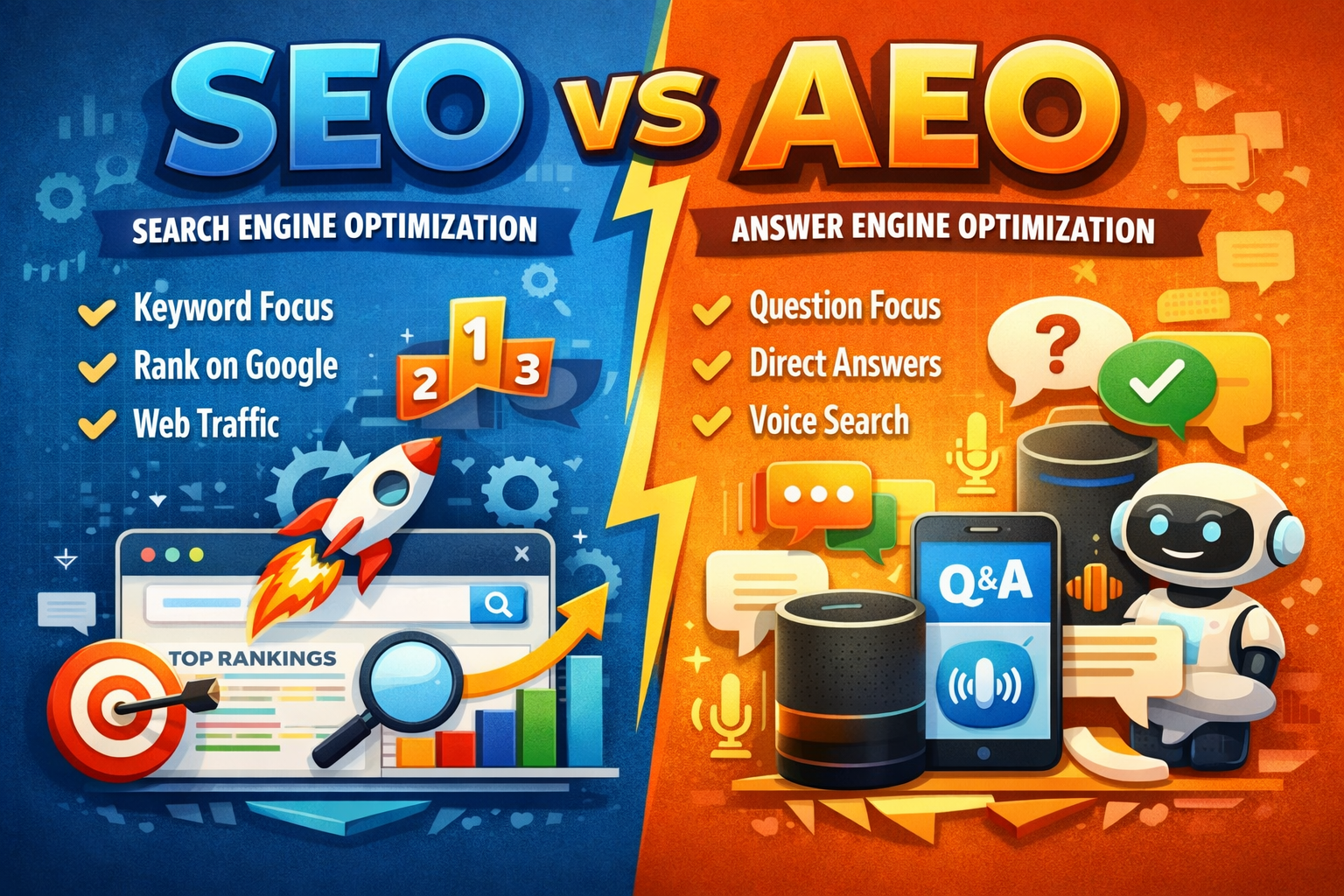
SEO (Search Engine Optimization) is the practice of getting your website to rank near the top of Google results for relevant searches. Most business owners are familiar with this concept, even if they have not fully implemented it.
AEO (Answer Engine Optimization) is the next layer. It means structuring your content and website so that AI systems like ChatGPT, Google Gemini, and Perplexity pull your information when answering user questions, even if the user never visits your website at all.
| Topic | SEO | AEO |
|---|---|---|
| Goal | Rank on Google first page | Get mentioned by AI when people ask |
| Measured by | Rankings, organic traffic | AI citations, brand mentions |
| Content style | Keyword-rich, long-form | Direct answers, clear structure |
| Platform | Google Search | ChatGPT, Gemini, Perplexity |
| Replace SEO? | - | No - SEO is still the foundation |
Important note: SEO and AEO are not competing strategies. They reinforce each other. Research shows that 99% of URLs cited by AI systems already appear in Google Top 20. Strong SEO remains the foundation that AEO builds on.
This is not a future trend. It is already happening:
That gap between 70% and 20% is your opportunity. Businesses that build AI visibility now are setting themselves up well ahead of those who wait.
Different AI tools have different preferences for sourcing information. Understanding these distinctions helps you focus your efforts where they matter most.
ChatGPT tends to favour what the internet broadly agrees on. It draws heavily from Wikipedia, Forbes, Reddit, and established news sources. If your business is mentioned consistently across multiple independent sources, ChatGPT is more likely to surface it in recommendations.
Google Gemini leans on Google own ecosystem - Google Business Profile, TripAdvisor, Yelp, and websites that Google already trusts. A fully completed Google Business Profile with strong reviews carries roughly 20% weight in Gemini local recommendations.
Perplexity emphasises community-generated content: Reddit threads, YouTube reviews, and TripAdvisor listings. For hotels and hospitality businesses in particular, TripAdvisor presence is especially influential with Perplexity.
Common signals that all three AI systems weight positively:
None of these require technical expertise. All of them can be started immediately.
1. Add FAQ Sections to Every Key Page
Your service pages, about page, and pricing page should each include a FAQ section at the bottom. Research shows that well-structured FAQs increase the likelihood of AI featuring your content by 60%. Write in a direct question-and-answer format. Ask what your customers actually ask, and answer clearly within two to three sentences.
2. Install Structured Data (Schema Markup)
Structured Data is code that tells AI systems exactly what your website is - a hotel, a local business, a FAQ, a review. Websites with proper Schema Markup have a 61.7% higher AI citation rate than those without. On WordPress, this is straightforward with plugins like Yoast SEO or Rank Math. No coding required.
3. Complete Your Google Business Profile to 100%
Business name, address, phone number, opening hours, category, photos, and responses to every review. A complete profile carries approximately 20% weight in Google Gemini local recommendations and strengthens your local SEO simultaneously. It is free and takes less than an hour to complete properly.
4. Write Blog Posts That Answer Real Customer Questions
Longer is not better. A focused 700 to 1,000 word post that answers one question well outperforms a 3,000 word post that wanders. Short paragraphs, clear subheadings, and a direct answer in the opening paragraph - that is the format AI systems prefer and reward.
5. Build Reviews Consistently, Not in Bursts
Consistency signals trust to AI systems more than volume alone. Receiving a few new reviews every week is more effective than getting 50 at once and then going quiet for six months. This applies to Google, TripAdvisor (for accommodation businesses), and Facebook. Respond to every review - positive and negative.
6. Keep NAP Consistent Across All Platforms
NAP stands for Name, Address, Phone. If your website says Hotel X but your Facebook page says Hotel-X Resort and your Google listing says something else entirely, AI systems cannot confidently identify them as the same business. Audit every platform where your business appears and standardise every detail.
7. Generate Digital PR and Brand Mentions
Being mentioned by external sources - travel blogs, industry websites, local news, YouTube creators - signals credibility to AI. Write guest articles, partner with bloggers, or share newsworthy updates with local media. Each independent mention strengthens your AI visibility in a way that on-site content alone cannot replicate.
Everything described above - SEO foundations, Schema Markup, fast-loading pages, well-structured content - depends on having a website that was built correctly from the start.
9dev builds websites and digital systems for Thai businesses, with a particular focus on hotels, resorts, boutique properties, and SMEs.
For hotels and accommodation businesses, we offer a complete system:
For general SMEs, we offer a One-Page Website that loads fast, looks professional, and provides the clean foundation that AEO requires.
If you would like to talk through what your business needs, our team is happy to advise - no pressure, no obligation.
Do I need to stop doing SEO to focus on AEO?
Not at all. They work together. Research shows that 99% of URLs cited by AI systems already rank in Google Top 20. SEO remains the foundation - AEO builds on top of it.
Can a small business like a 20-room hotel or local SME actually do AEO?
Yes - and small businesses often have an advantage. They can rank for niche, location-specific queries more easily than large brands. A complete Google Business Profile, consistent reviews, and a website with FAQ sections are enough to start seeing results.
What is Schema Markup and can I add it myself?
Schema Markup is structured code that tells AI and search engines what your website represents - a hotel, a business, a FAQ, a review. On WordPress, plugins like Yoast SEO and Rank Math handle this without any coding. For other platforms, a web developer can add it in an afternoon.
How long before I see results from AEO efforts?
For AI tools that crawl the web regularly, such as Perplexity, results can appear within one to three months. For ChatGPT, which updates its training data less frequently, it may take longer. Consistency matters more than timing - build the signals steadily rather than expecting a single action to produce immediate results.
Where exactly do I need to check NAP consistency?
Every platform where your business has a presence: your website, Google Business Profile, Facebook Page, Line OA, TripAdvisor (for accommodation), and any local directories. The spelling, formatting, and details must be identical across all of them.
My business does not have a website yet. Can I still start with AEO?
You can start with Google Business Profile and review building, but a website is an essential foundation that cannot be skipped. AI systems need credible URLs to cite. Without a website, you are limiting how far AI visibility can grow. If you do not have one yet, that is the right first step.